Verify before
the load leaves.
One photo of the shipping paper. Under a minute later you have the placards 49 CFR requires, every determination cited, a segregation check, and an inspection-ready Evidence Packet you keep.
STRUCK THROUGH ON THE PAPER—
CLASS 8 · PG II · 500 GAL BULK8
CLASS 8 · PG II · BULK8
CLASS 8 & 9 · PG III · PG 2 OF 29
Waste sodium hydroxide solutionCLASS 8
Waste corrosive liquids, toxic, n.o.s.CLASS 8
NA3266 · NA3077 ×2 · NA3082 (Class 8 & 9)PAGE 2
Struck through on the paper → flagged voided, not countedVOIDED

§172.504(a)
§172.504(c) · Cl 9 not counted, (f)(9)
A replay of one actual scan — a two-page handwritten waste manifest, struck-through line and all. Playback compressed; the real scan took 46.1 seconds, server-recorded (scan hg-ms26r1s6-wjxk, demo deployment, same engine build as production). Identities redacted; materials, segregation, and timing are the scan's engine output. The placard row shows the current engine's result on the same paper, updated October 2026 when Class 9 weight stopped counting toward the 1,001 lb total. One document, one run — your time varies with pages and paper quality.
What a paperwork miss actually costs
A compliance check in under a minute, cited to 49 CFR — caught before you load, not discovered at the scale house.
Shipping hazmat? For shippers → · Brokering freight? For brokers →
HaulGuard documents and assists — your verification is the legal record. It catches and flags what it can read, and it documents what was checked; it does not certify compliance.
Lawyer-drafted Terms · Privacy · Live status · Offline capture — scans upload when coverage returns
Three steps from cab
to Evidence Packet.
You just watched a real scan. Here's the step that makes it a legal record — you verify, then hand it over. Built for a driver at a truck stop with one hand on the wheel.
Scan
Snap the Bill of Lading or manifest — the AI reads every material and cites the 49 CFR section behind each placard.
You verify
This is where HaulGuard earns its keep. You check every extracted row against the paper; every correction is captured with full provenance — what the AI read, what you changed, and why. Your verification, not the OCR, is the legal record.
Hand over
The Evidence Packet PDF generates — placards, attestations, CDL credentials, and a SHA-256 hash chaining it all. Hand it to a DOT officer at roadside.
See HaulGuard working.
Real screens from the driver app, public verifier, and fleet dashboard — captured on a sample fleet, not mockups. Tap any image for the full screen.
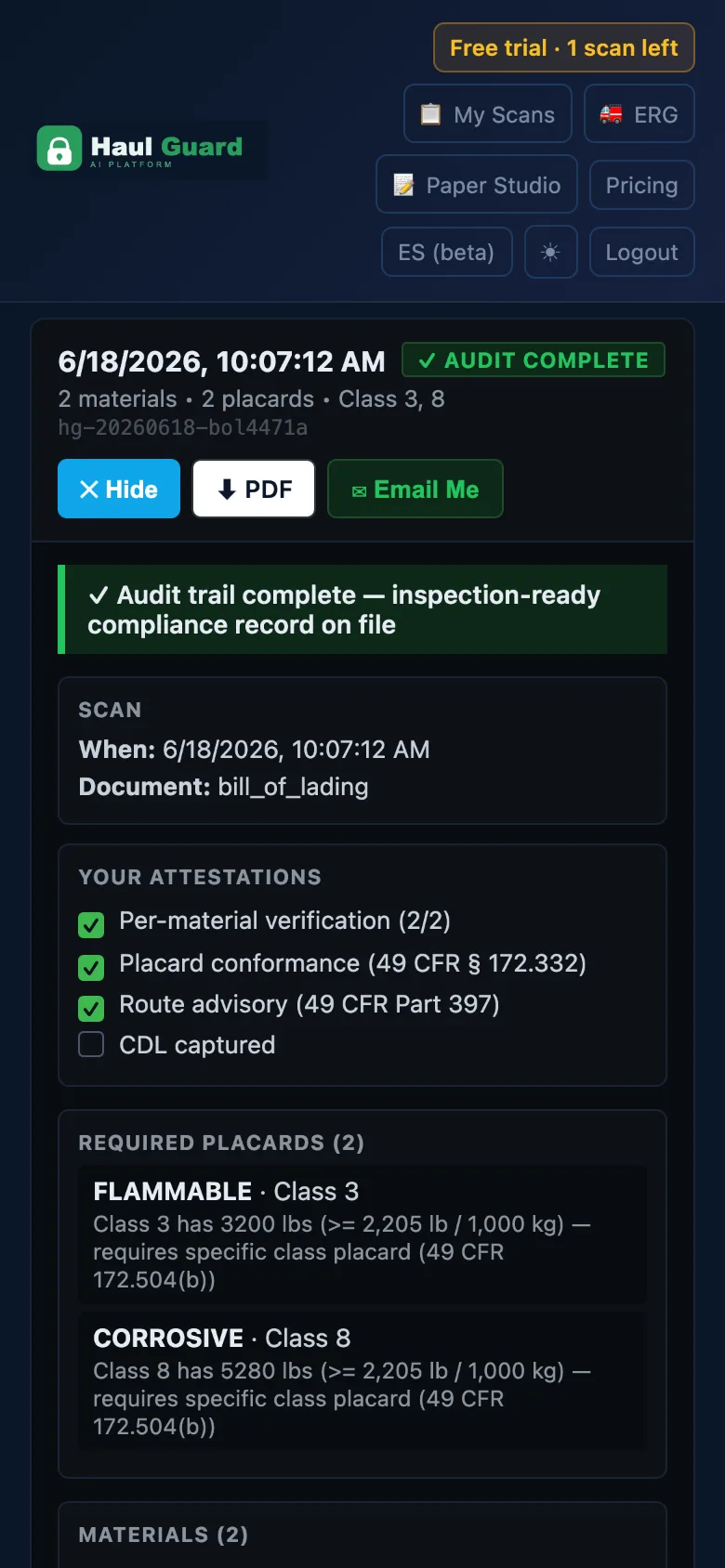
A completed driver record
Placards, cited reasoning, driver attestations, and audit status in one place. What to notice:
- ✓AUDIT COMPLETE — every attestation on file before the wheels turn.
- ✓Each attestation cites its rule — placard conformance to § 172.519, and a signed acknowledgment that route selection under Part 397 stays with the carrier.
- ✓PDF button — the Evidence Packet a driver hands an inspector, generated from this record.
Tap the image to see the full screen.
Inside your
Evidence Packet.
One PDF with everything a DOT inspector or post-incident auditor would ask for — generated for every scan, downloadable and emailable. Scan ID, timestamps, driver, and carrier on the cover.
And the honest part, in print: AI output is best-effort — your verification is the legal record, not the OCR extraction.
Illustrative sample — the format and information in every real packet
Illustrative sample load. Every real packet prints its own scannable QR; an inspector verifies the chain at haulguard.ai/verify with no account.
Every section grounded in the live Terms of Service, EULA, and Privacy Policy — drafted by outside counsel.
One driver scans.
The whole fleet gets safer.
Every driver scan rolls up: which shippers hand your fleet defective paperwork, where verification discipline slips, and a scan-discipline evidence export (PDF) you can put in front of an insurer — with the sample size shown next to every rate.
Real product. Real artifacts.
No "coming soon".
Every feature below is shipping in production today. Items still on the roadmap aren't on this page on purpose — when they ship, they show up here.
AI hazmat scanner
Bill of Lading and hazmat manifest OCR. Extracts every material with UN number, hazard class, packing group, weight, ERG. Determines required placards under 49 CFR § 172.504 and runs the segregation matrix check from § 177.848.
CDL credential capture
Front + back OCR with HME (Hazmat) expiration parsing. Each field tagged with provenance — OCR-extracted, driver-corrected, or driver-attested — so an inspector can see exactly how every credential value was sourced.
Tamper-evident Audit Ledger
Every scan, attestation, credential capture, and admin action lands in an append-only SHA-256 hash-chained ledger. An auditor or opposing counsel can independently verify integrity with one command. 3-year minimum retention enforced by design.
Inspection-ready Evidence Packet
Single PDF combining the placard determination, driver attestations, CDL credentials, and audit chain proof. Generated for every scan. Downloadable, emailable, and shareable as a tamper-evident URL with QR code for first responders.
Built by a hazmat driver,
not a software company.
I hauled hazmat for eight years. Before every load, the same questions: are these placards right, is this BOL complete, will this paperwork hold up if I get inspected. The answers lived in a regulation book — not on the paper in my hand at the dock.
HaulGuard is the tool I wanted in the cab: photograph the paper, see the placards 49 CFR requires with the citation next to each one, verify it yourself, and keep a record that proves you checked — before the wheels turn.

Zackary Foster
Founder, HaulGuard AI · 8 years hazmat CDL
Try it free.
Scan your first load today.
One free scan with the full audit trail. No credit card required to start. Founding Member pricing locks in for 12 months from your first paid month.
The real driver app · sample fleet data · not a mockup